Cappadocia Pigeon House’s
People have built numerous pigeon houses, birdhouses, and dovecotes in Cappadocia to obtain pigeon manure, and they have adorned their surroundings as well. These carved pigeon houses and the decorations around them are important artistic areas in Cappadocia.
The pigeon is one of the first animals domesticated by humans. This domestication probably took place around 4,000 BC. People have bred pigeons in different species for their manure, meat, as well as for using their flying and navigation abilities as carrier pigeons. Since pigeon manure was used in gunpowder, pigeons became the most commonly bred birds in Europe in the late Middle Ages.
The pigeon is a bird blessed in the Torah. It was sent during the Noah’s Flood to determine if the waters had receded. “Then he sent out a dove to see if the water had receded from the surface of the ground. But the dove could find nowhere to perch because there was water over all the surface of the earth; so, it returned to Noah in the ark.

” (Genesis 8:8-9). In the Bible, the pigeon symbolises the Holy Spirit. A dove descends from the sky during John’s baptism of Jesus. When Prophet Muhammad was fleeing from the Quraysh, a pigeon provided him assistance in a cave where he sought refuge.

The pigeon and the olive branch it carries still symbolise peace and friendship.
In Turkey, there is generally a special affection for birds, particularly for doves and turtledoves. During the Ottoman period, birdhouses, sparrow palaces, and even bird hospitals were built in various structures. When a bird defecates on us, it is considered a good omen or a sign of good luck.
Haci Paulos Melitopulos, one of the families sent to Greece through the population exchange, said in an interview in 1956: “South of Urgup, along the road towards Sinasos, by the banks of the Uzengi Stream, there was another white and soft rock rising. We had about 500-600 dovecotes belonging to Urgup and the Turkish village Ortahisar there.
The dovecotes by the Uzengi Stream were more productive because the stream flowed by them. Anyone who had the means could build a dovecote for themselves, and no one would prevent them. We only built the dovecote. The pigeons would naturally build nests there, and since they were not tamed, we didn’t know how many pigeons we had.
Could you count them? Once a year, before the pigeons started to mate, in February or early March, we would collect their manure. We would fill sacks with it, bring them to Urgup, and use them as fertiliser for vineyards, clover fields, and gardens. It was the highest-quality manure, and it was sold at a high price.

For example, I would earn 120 banknotes, which is approximately 40 gold liras, from my two-story dovecote. It was not a small amount of money, and the expenses were negligible.”
In order to collect the droppings of pigeons, which generally live in flocks, feed on grain seeds, and drink a lot of water, people built pigeon houses near rivers, streams, and springs and placed importance on pigeon breeding. These structures, which are realised for pigeons, are called “güvercinlik” in Cappadocia and “boranhane” in Diyarbakir.
In Cappadocia, pigeon manure has been accumulated in dovecotes carved into rocks for centuries, especially for vineyards. According to the memoirs of some Orthodox people who lived in Cappadocia, there were some who made a lot of money from this business.
The construction of rock-carved pigeon houses in Cappadocia dates back to ancient times, but the majority of the adorned and decorated pigeon houses we see today can be traced back to the 19th century. Pigeon houses are found all over Cappadocia.
However, the largest number of rock-carved pigeon houses are located in Kızılçukur, Güllüdere, Kılıçlar, Soğanlı, Üzengi, and Balkan Deresi valleys, as well as in Güvercinlik Valley near Uçhisar.
Some of the pigeon houses were made by closing the windows and entrances of the spaces carved in rocks. There are also those directly carved as pigeon houses, as seen in Güvercinlik Valley, for example.
A traveler describes the pigeon houses he saw in 1936 as follows: ‘The district called Güvercinlik in the eastern part of the city; it’s neither a neighborhood nor a village; it’s a completely different, marvelous world.
Steep rocks separating the valleys, or stone cones rising between the valleys, have a door big enough for a person to enter, and around the door and on the face of the rock, there are fifteen or twenty small windows.
Pigeons enter and exit through these windows, but they are neither cages nor coops nor huts; their interiors are like a multi-room apartment building carved out of stone in the heart of the mountain.’

The pigeon houses are generally designed as small chambers with openings in their walls for pigeons to roost and lay eggs. They are also designed near water sources and in secure heights, taking into account the pigeons’ frequent need for water. Some of the pigeon houses made directly for pigeons are 7-8 stories high.
Rooms with a capacity for at least a hundred pigeons have been designed, sometimes with long wooden perches placed inside. Since many pigeon houses are built on high hills, hand-carved stairs have also been created on steep rocks to provide access to them. Generally, there are also holes on the facades of the pigeon houses where birds can roost.
The protection of pigeons and their eggs against animals such as foxes, martens, and weasels that may want to reach them has also been considered. Two methods have been developed to make these animals slip: one is quite new, placing tin or zinc plates around the entrances of the pigeon houses.
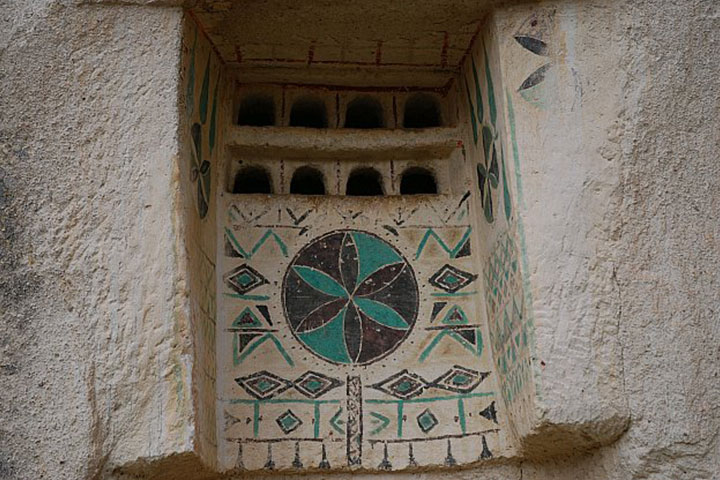
The other is an old method: mainly coating the pigeon house entrances, mostly arranged in two rows with 2-3 holes, with a slippery mixture made of natural white paint, plaster and egg white, and lime cream. The whiteness also attracts the attention of the pigeons.
However, an aesthetic effort has been made with this coating: not leaving the white slippery mixture plain and decorating it with root dyes and embellishments. This has resulted in a surprising and rare example of Turkish-Islamic folk art.
These decorations, mostly realized between the late 19th century and the first half of the 20th century, include geometric motifs (such as diamond patterns, veins, triangles, circles, and the wheel of fortune often used in Seljuk art), plant motifs (flowers, the symbol of abundance, pomegranates, and the tree of life, which Turks have used since ancient times), and some bird motifs.
In addition to these decorations, small plaques with the Arabic letters spelling “maşallah” (a phrase expressing appreciation or protection from the evil eye) have also been included. Some of these decorations can also be seen among the carpet and kilim designs produced in the region.
After the Orthodox Christians left the region through the population exchange, those who came to Cappadocia turned some houses and unused churches into pigeon houses. They closed the doors and windows and left a few holes for pigeons to enter and exit. This effort, as seen in examples like Çavuşin, Kılıçlar Meryem Ana, and Dark Church, ensured the preservation of the wall paintings.
In the meantime, it is also worth mentioning the woven wall tower-like pigeon houses built around the famous Gesi town in the northeast of Kayseri, especially in the Kayabağ neighborhood, with fertilizer storage underneath.
In this astonishing land, once upon a time, humans and fairies lived together in harmony. Fairies used to assist humans in every aspect. They even entered squeezed grape juice and made them intoxicated. But one day, the son of the Sultan fell in love with the fairy Sultan’s daughter.
This situation caused concern in the hearts of the people, and they began to fear, thinking, “What will be our fate if we mix fairies among us?” Eventually, they disguised themselves as hunters and attacked the fairies. The fairies then transformed into pigeons and took flight. These pigeons, although their numbers have decreased today, continue to flap their wings in Cappadocia. Fairies turn into pigeons during the day and into light during the night.
⇒ Go Turkey / Cappadocia
Prepared & Edit by :